Digital Printing vs Gravure Printing for Custom Pouches: Low MOQ or Bulk Production?
Compare digital printing and gravure printing for custom flexible packaging. Learn when to choose low MOQ digital printing and when gravure printing is better for bulk pouch orders.
Digital Printing vs. Gravure Printing for Custom Pouches: Which One Should You Choose?
If you are sourcing custom flexible packaging for the first time, the printing options can feel confusing.
One supplier tells you they can start from 500 pieces.
Another supplier says the MOQ should be 5,000 or 10,000 pieces.
One says there is no plate fee.
Another says gravure printing gives better unit cost for large orders.
So which one is actually right?
The answer depends on your product stage, order quantity, design plan, budget, timeline, and how many SKUs you need to test.
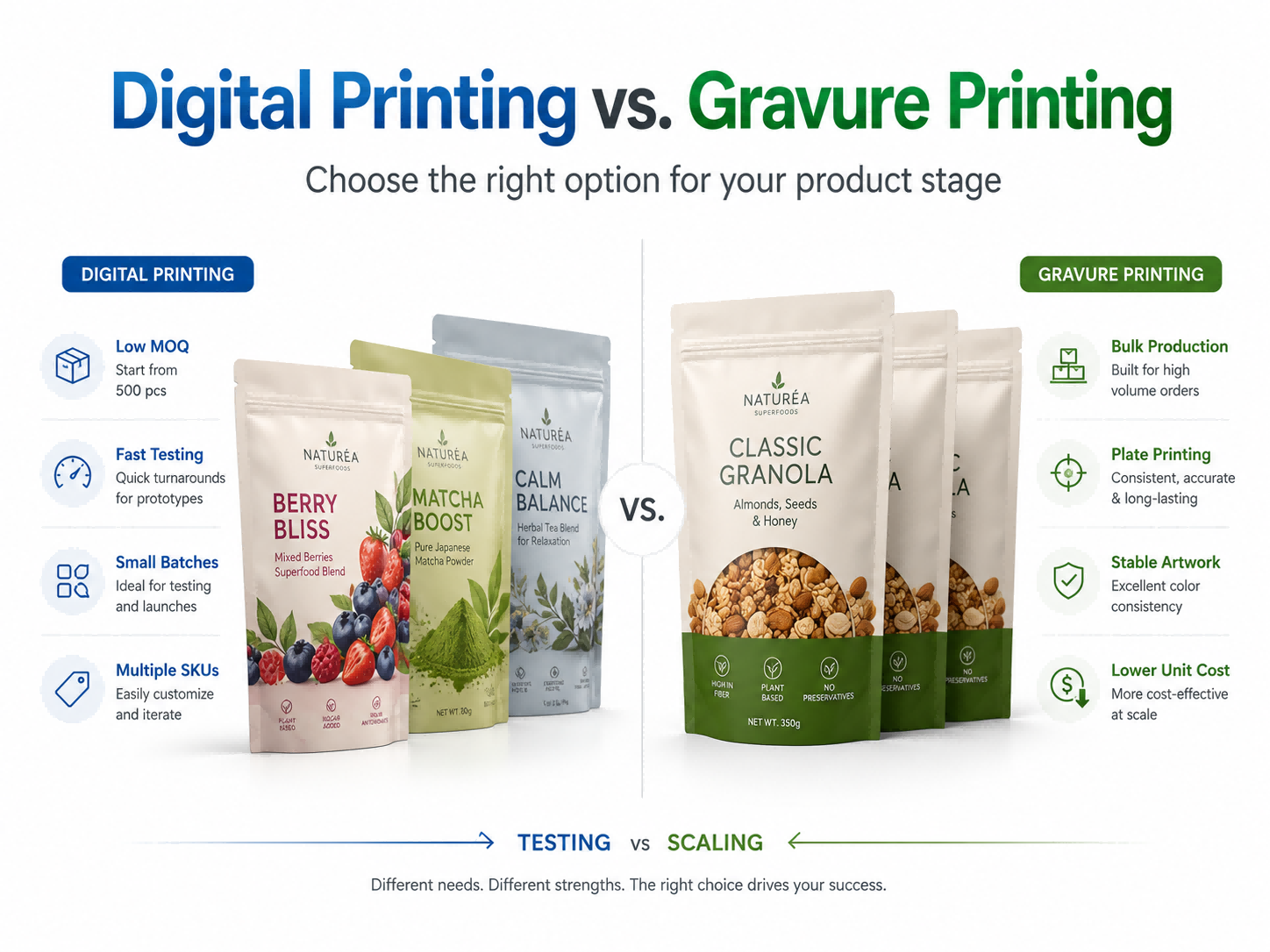
For custom pouches, both digital printing and gravure printing can be good choices. The key is not choosing the “better” method, but choosing the method that fits your current business situation.
The Real Question: Are You Testing or Scaling?
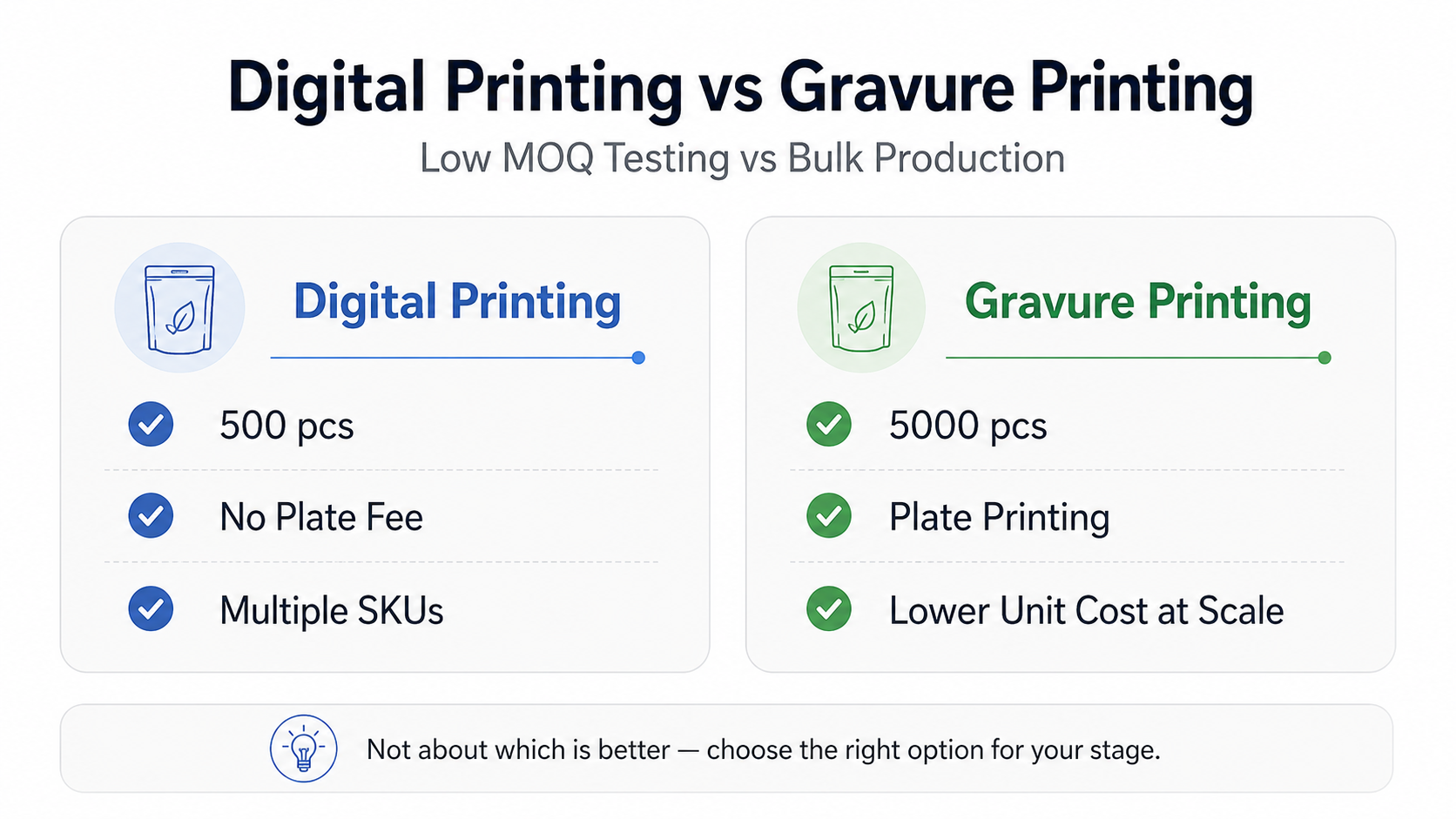
Before comparing printing methods, ask yourself one practical question:
Am I testing a product, or am I already scaling a proven product?
If you are launching a new product, testing packaging artwork, trying several flavors, or checking market response, digital printing is usually more practical.
If your product already sells steadily, your artwork is finalized, and you need a larger quantity with lower unit cost, gravure printing may be the better long-term option.
This is where many brands make mistakes. They choose a printing method based only on unit price, but ignore risk, inventory pressure, artwork changes, and product testing needs.
What Is Digital Printing for Flexible Packaging?
Digital printing is a direct-to-film printing method. It does not require printing plates, so the setup is faster and more flexible.
Your artwork can be printed directly onto flexible packaging film, such as PET, PE, kraft paper laminated film, or other pouch materials, depending on the final structure.
For new brands, product managers, small-batch sellers, and companies with multiple SKUs, digital printing solves three common problems:
high MOQ, long lead time, and expensive setup cost.
Why Brands Choose Digital Printing
1. No Plate Fees
Traditional gravure printing requires printing cylinders or plates. Digital printing does not.
This means you can avoid upfront plate costs, especially when your design is still changing or your order quantity is not large enough.
For a new product launch, this matters. You may not want to spend money on plates before you know whether the product sells.
2. Lower MOQ for Product Testing
Digital printing is especially useful when you need small batches.
For example, a coffee roaster may want to test 3 bag designs.
A snack brand may want to launch 5 flavors.
A pet treat brand may want different pouch designs for different products.
With digital printing, you can start with a lower MOQ and avoid ordering too much inventory too early.
At TM-Future, digital printing projects can often start from around:
The exact MOQ still depends on pouch size, material, bag type, and production requirements.
3. Faster Turnaround
Because there are no plates to make, digital printing can reduce preparation time.
This is helpful when:
You need samples quickly
You are preparing for a product launch
You need packaging for a seasonal promotion
Your artwork is ready and you do not want long setup delays
For many small-batch custom pouch projects, digital printing can be a faster way to move from artwork to finished packaging.
4. Better for Multiple SKUs
If your product line has several flavors, sizes, regions, or seasonal designs, digital printing gives you more flexibility.
For example:
6 coffee origins
4 snack flavors
3 pet treat recipes
Limited-edition packaging
QR code or batch code variations
With digital printing, multiple designs can often be handled more flexibly than traditional plate-based printing.
This is especially useful for brands that want to test packaging and product combinations before committing to large inventory.
When Digital Printing May Not Be the Best Choice
Digital printing is flexible, but it is not always the lowest-cost option for large-volume production.
If you need tens of thousands or hundreds of thousands of pouches with the same artwork, gravure printing usually becomes more cost-effective.
Digital printing is best for:
New product launches
Small-batch orders
Low MOQ custom pouches
Multiple SKU testing
Short lead time projects
Seasonal packaging
Artwork validation
Market testing
It is not always the best choice for:
Very large repeat orders
Highly strict spot color control
Long-term mass production
Lowest possible unit cost at scale
What Is Gravure Printing for Custom Pouches?
Gravure printing is a traditional high-volume printing method widely used in flexible packaging.
It requires printing cylinders or plates. This means there is a setup cost and longer preparation time, but once everything is ready, gravure printing is very efficient for large production runs.
For mature brands and stable products, gravure printing can offer strong advantages.
Why Brands Choose Gravure Printing
1. Better Unit Cost for Large Orders
Gravure printing usually has a higher initial setup cost because of plate or cylinder fees.
But when the order quantity is large enough, the unit price becomes more competitive.
For example, if you need:
5,000 pcs
10,000 pcs
50,000 pcs
100,000 pcs
gravure printing may give you a better cost structure than digital printing.
This is why many established food, coffee, snack, pet food, and retail brands still use gravure printing for regular bulk orders.
2. Strong Color Consistency for Repeat Orders
Gravure printing is suitable for stable, repeated production.
If your packaging design is finalized and you need the same colors again and again, gravure printing can provide good consistency across production batches.
It is also suitable when your artwork uses brand-specific colors, strong solid-color areas, or refined packaging effects.
3. More Cost-Effective for Single Large SKU
If you only have one or two main products and each product sells steadily, gravure printing is often more practical.
For example:
One best-selling coffee bag
One main pet food pouch
One snack pouch sold in bulk
One frozen food pouch for regular supply
In these cases, paying plate fees can make sense because the cost is spread across a larger quantity.
4. Suitable for Mature Packaging Systems
Gravure printing is often a good fit when:
Artwork is finalized
Product demand is stable
Order quantity is high
SKU count is limited
The brand needs repeat production
The goal is lower unit cost
At TM-Future, gravure printing projects usually start from around:
MOQ: 5,000 pcs
The actual MOQ depends on pouch size, material structure, printing colors, bag type, and production setup.
Digital Printing vs. Gravure Printing: How to Choose
Here is the simplest way to decide.
Choose Digital Printing If:
You are launching a new product
You need low MOQ
You want to test packaging before scaling
You have multiple SKUs or flavors
You need faster turnaround
You want to avoid plate fees
Your artwork may still change
You want to reduce inventory risk
Digital printing is not only about “small quantity.”
It is about reducing risk and giving your brand more flexibility.
Choose Gravure Printing If:
Your product already sells well
Your artwork is finalized
You need a larger quantity
You want lower unit cost at scale
You need stable repeat production
You have fewer SKUs
You can accept plate fees and longer setup time
Gravure printing is not outdated.
It is still a strong option for mature brands that need reliable large-volume production.
A Practical Example
Imagine you are launching a new snack brand with 4 flavors.
You are not sure which flavor will sell best.
You may still adjust the package design after customer feedback.
You do not want to hold too much inventory.
In this case, digital printing is usually the smarter first step.
You can print smaller quantities for each flavor, test the market, collect customer feedback, and improve the artwork before scaling.
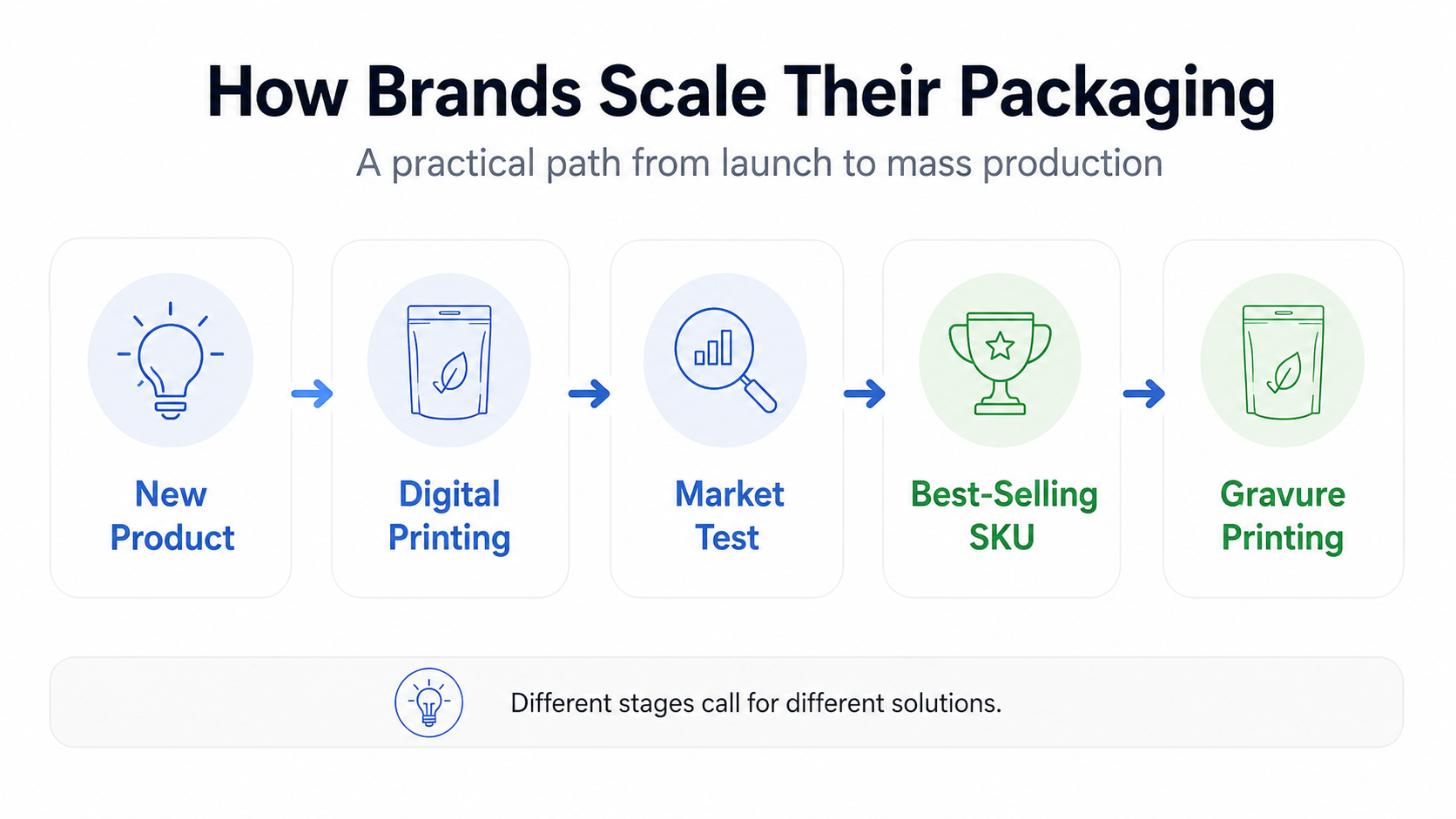
Later, if one flavor becomes a strong seller and the design is stable, you can move that SKU to gravure printing for better unit cost.
This is a very practical path:
Digital printing first → Market testing → Design improvement → Gravure printing for bulk orders
This approach helps brands avoid over-ordering too early while still preparing for long-term cost control.
Another Example: A Mature Coffee Brand
A coffee brand already sells one best-selling 250g coffee bag every month.
The design is fixed.
The brand color must stay consistent.
The order quantity is stable.
The brand wants to reduce unit cost.
In this case, gravure printing may be more suitable.
Even though there is a plate fee at the beginning, the cost can be spread across repeat orders. For a stable product, gravure printing can be a better long-term production method.
What Customers Often Search Before Choosing
Many buyers do not search “digital printing benefits” directly.
They search real problems like:
custom coffee bag low MOQ
custom pouch without plate fee
digital printing vs gravure printing packaging
how many custom pouches should I order
best printing method for snack packaging
custom packaging for multiple flavors
low MOQ food packaging bags
custom pouch sample before bulk order
is gravure printing cheaper for large orders
how to reduce packaging inventory risk
These questions are not only about printing.
They are about risk, budget, launch timing, and decision confidence.
That is why the best printing choice should come from your business stage, not only from the printing machine.
How TM-Future Helps You Choose
TM-Future supports both digital printing and gravure printing for custom flexible packaging projects.
We do not simply push one printing method. Instead, we help review your product type, pouch size, order quantity, SKU plan, artwork status, target market, and budget before recommending a practical production route.
For new brands, small-batch testing, and multi-SKU product lines, digital printing may help reduce risk and speed up launch.
For mature products, stable designs, and larger repeat orders, gravure printing may offer better long-term cost efficiency.
You can start small, test smarter, and scale when the product is ready.
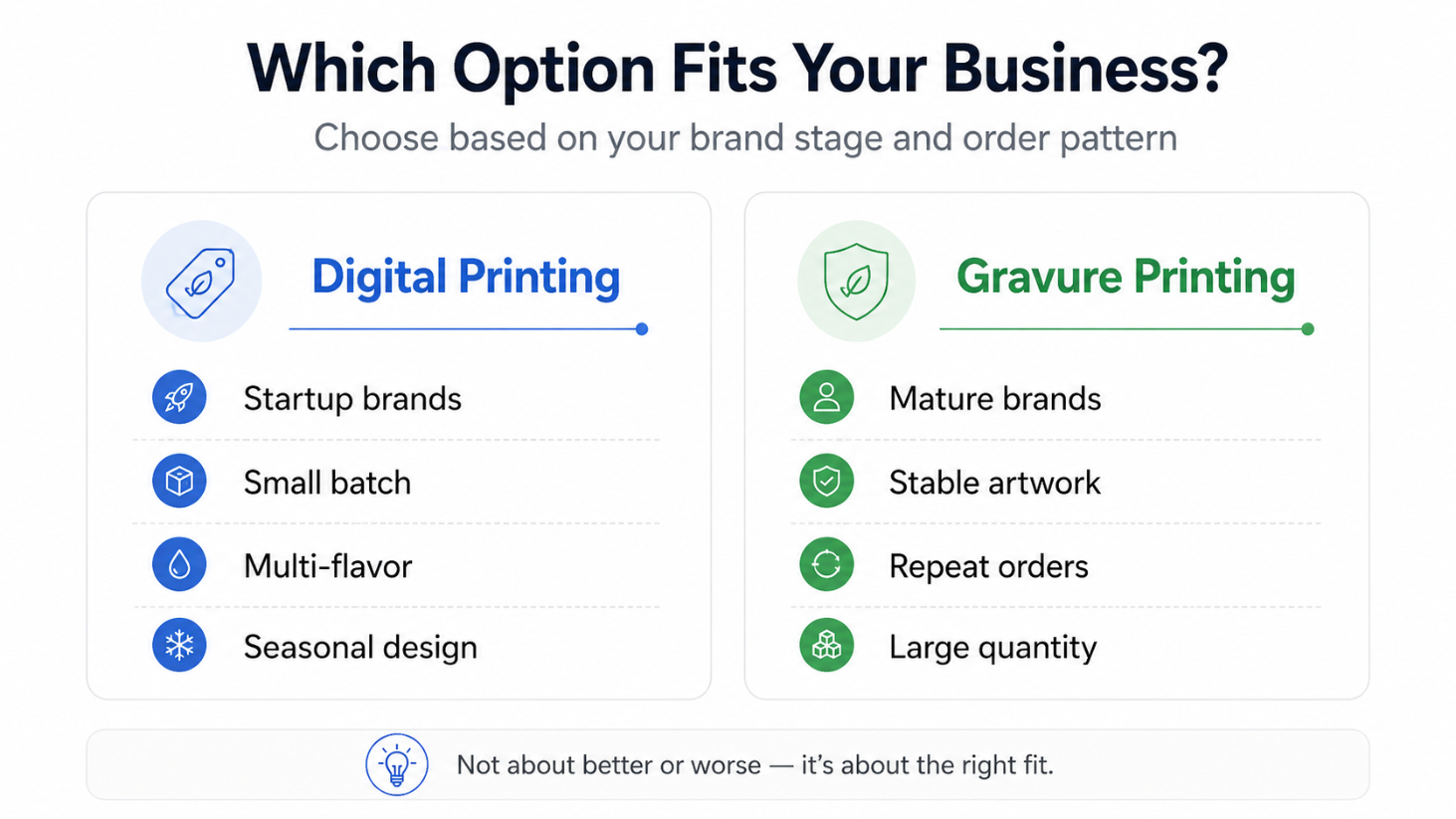
Quick Comparison
Printing Method | Best For | MOQ Direction | Main Advantage | Things to Consider |
|---|---|---|---|---|
Digital Printing | New products, low MOQ, multiple SKUs | Around 500 pcs | No plate fee, faster setup, flexible designs | Unit cost may be higher for large orders |
Gravure Printing | Mature products, bulk orders, stable designs | Around 5,000 pcs | Better unit cost at scale, stable repeat printing | Plate fee and longer setup time |
Final Suggestion
Do not choose printing only by asking:
Which one is cheaper?
A better question is:
Which printing method fits my current product stage?
If you are still testing, digital printing can help you avoid unnecessary risk.
If you are ready to scale, gravure printing can help you control unit cost.
The right printing method should support your launch plan, your budget, your product line, and your next stage of growth.