
Sep 18, 2026Find a Supplier
What to Ask a Jewelry Supplier in China Before Ordering
Choosing a jewelry supplier in China? Ask these practical questions about materials, MOQ, stock, samples, QC, lead time, OEM, packaging and reorders before paying.
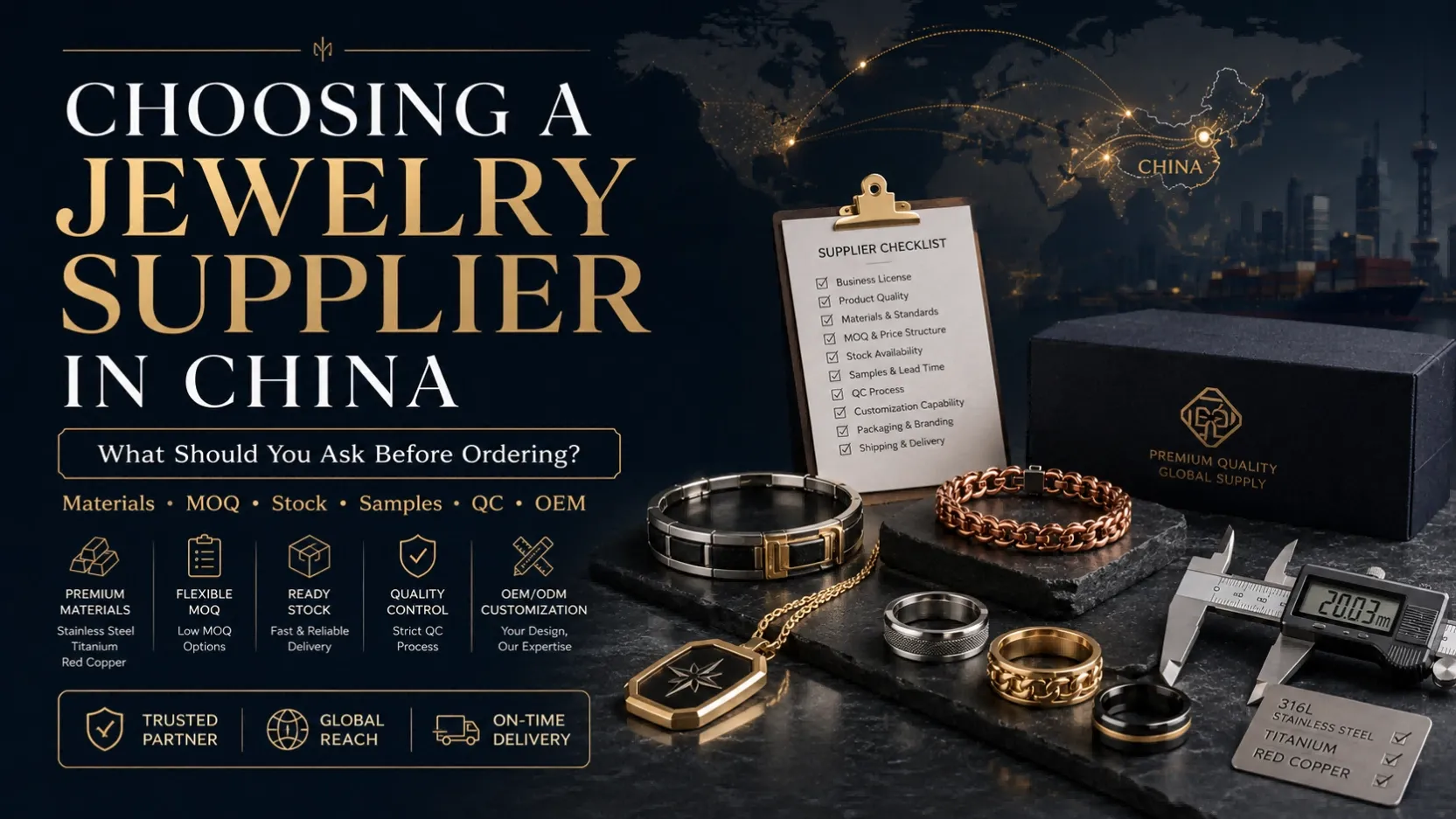
Finding a jewelry supplier is not usually the hard part.
Open Google, Alibaba, social media or a sourcing platform and you can find hundreds.
The difficult part is deciding:
“Which one should I actually order from?”
A polished website does not answer that question.
Neither does a low quotation.
Before placing a first order, we think buyers should ask practical questions that reveal how the supplier actually works.
Not:
“Are you professional?”
Almost everyone will say yes.
Ask questions that have specific answers.
1. What Is the Actual Material?
Start here.
If the listing says:
“Stainless steel bracelet”
ask:
“Which stainless steel grade?”
If it says titanium, ask:
“Is this pure titanium or titanium alloy?”
If it says copper, ask:
“Is it solid copper or copper plated?”
At Tai Mei Future, our main jewelry materials include:
- 316L stainless steel
- pure titanium
- 99.9% pure red copper
The product title should match the actual material.
If material is part of your own selling point, this is something worth confirming before you place the order.
2. Is the Product Really in Stock?
This question sounds simple.
But ask it more specifically.
Not only:
“Is this in stock?”
Ask:
“How many pieces are available now?”
There is a big difference between:
5 pcs available
and
500 pcs available.
If you are testing products, a small quantity may be enough.
If you already know you need 300 pieces, current inventory becomes much more important.
Ready stock changes as orders are shipped, so we normally confirm actual availability before an order is finalized.
3. What Does Your MOQ Actually Mean?
A supplier may advertise:
MOQ 10 pcs
but you still need to know:
Is that:
- 10 pcs per style?
- 10 pcs per color?
- 10 pcs per size?
- 10 pcs for the whole order?
Those are very different purchasing conditions.
For many of our ready-stock products, the standard starting quantity is:
5 pcs per style.
Different available styles can be mixed.
But customized production is different.
OEM MOQ depends on the actual design and manufacturing requirements.
This is why buyers should not treat:
ready-stock MOQ
and
custom-production MOQ
as the same thing.
4. Can I Mix Different Styles in One Order?
If you are a smaller buyer, this can be more important than getting the lowest possible unit price.
Imagine two suppliers.
Supplier A:
$3.00 per bracelet, 100 pcs per style
Supplier B:
$3.30 per bracelet, 5 pcs per style, mixed orders allowed
Which is cheaper?
For a buyer who already sells thousands of the same bracelet, Supplier A may make sense.
For somebody testing twenty new designs, Supplier B may create much less inventory risk.
So don't compare price without comparing order flexibility.
5. Can I Mix Different Materials?
If you want to test your market, ask whether you can combine:
- stainless steel
- titanium
- copper
in one buying stage.
This can be useful because customers do not always choose the material you expect.
A store may begin believing stainless steel will be its strongest category and discover that titanium performs better.
Or a few copper bracelets may attract a completely different customer group.
Mixed-material testing gives you real information.
6. Can You Send Real Product Photos?
Catalog images are useful.
But real photos tell you something different.
Ask to see:
- front
- back
- inside
- clasp
- surface detail
- packaging
For magnetic jewelry, the inside is particularly important.
You should be able to see:
- magnet position
- element arrangement
- internal finish
Two bracelets can look almost identical from the front while having very different inside structures.
7. Can I See the Actual Dimensions?
Do not judge jewelry size from a photo.
Ask for real numbers.
Depending on the product:
- length
- width
- thickness
- diameter
- ring size
- chain length
- weight
This matters more than many first-time buyers expect.
A 6 mm bracelet and a 12 mm bracelet may look similar in an enlarged website image.
On the wrist, they feel completely different.
8. Can I Order a Sample Before a Larger Order?
If you are comparing suppliers, a sample can save you from a much more expensive mistake.
A sample lets you check things that are difficult to understand online:
- actual weight
- polishing
- color
- clasp feel
- sharp edges
- stone setting
- bracelet flexibility
- magnetic layout
- overall product feel
Sometimes a supplier with the best catalog photo is not the supplier with the best physical product.
You only find that out when the sample is in your hand.
9. What Should I Check When the Sample Arrives?
Do not look at it for ten seconds and say:
“Looks good.”
Use it.
For a bracelet:
Open the clasp several times.
Wear it.
Look at the inside.
Check the edges.
Compare the size.
For a ring:
Check the actual diameter.
Look at the inner surface.
Check whether stones are secure.
For plated jewelry:
Compare the real color with the photo you approved.
The goal of a sample is not only to see whether you like the design.
It is to see whether the supplier's product matches what was promised.
10. What Plating or Finishing Process Is Used?
This matters for colored jewelry.
If you are ordering:
- gold
- rose gold
- black
- two-tone jewelry
ask what surface process is used on that exact model.
For many of our stainless steel and titanium designs, we use PVD plating.
But a buyer should still confirm the specification of the actual product rather than assuming every colored jewelry item is processed the same way.
This is especially important if you plan to reorder later and need consistent color.
11. Will the Color Never Fade?
Be careful if a supplier answers every question with:
“Never.”
Jewelry is worn against skin.
It is exposed to:
- friction
- sweat
- cosmetics
- chemicals
- water
- storage conditions
Different materials and surface finishes behave differently.
Pure copper, for example, can naturally oxidize and change tone.
Plated jewelry also depends on the finishing process and how it is worn.
We prefer explaining the material honestly rather than promising something that cannot realistically be guaranteed forever.
12. Can You Explain the Inside of Magnetic Jewelry?
If you are buying magnetic or 4-in-1 jewelry, ask for the actual configuration.
Depending on the design, a product may contain:
- neodymium magnets
- germanium elements
- far-infrared elements
- negative-ion elements
Not every product has the same number or layout.
Ask:
“Can you show me the inside of this exact model?”
That is much better than accepting one generic diagram used across an entire catalog.
13. Do You Make Medical Claims About Magnetic Jewelry?
This is a useful supplier question too.
If a supplier promises that a bracelet can definitely cure, treat or prevent specific diseases, be careful.
A jewelry manufacturer can verify:
- material
- magnet type
- product structure
- dimensions
- finish
- element configuration
That does not automatically mean the product can make guaranteed medical claims.
For buyers selling online, exaggerated health claims can create unnecessary problems.
Product specifications should be clear.
Medical promises should be treated much more carefully.
14. How Long Does a Ready-Stock Order Take to Ship?
Ask for the factory preparation time separately from international transit.
For many available ready-stock products at Tai Mei Future, shipment preparation is normally around:
3–7 days after order confirmation.
That means the factory can prepare and dispatch the order.
It does not mean the parcel reaches every country within 3–7 days.
International delivery depends on:
- destination
- courier
- shipping method
- customs
- shipment size
Keeping those timelines separate avoids confusion.
15. How Long Does Custom Production Take?
Custom jewelry requires more time than ready stock.
For many of our OEM/ODM projects, production is typically around:
25–35 days after all product details are confirmed.
But a real lead time depends on the project.
It may change because of:
- new molds
- sample revisions
- special plating
- custom packaging
- complicated construction
- order quantity
So don't ask only:
“How fast can you make OEM?”
Show the supplier the actual project first.
Then ask for the estimated timeline.
16. Can You Reproduce the Same Product Later?
This is one of the most important questions for a business buyer.
Testing a product is useful.
Finding a best seller is better.
But then you need to know:
Can I get it again?
Ask whether the design:
- is regularly stocked
- can be reproduced
- uses standard components
- is planned for discontinuation
If a style becomes a regular product for your store, tell the supplier.
That information can matter for future stock planning.
17. What Happens If My Best Seller Is Out of Stock?
A good supplier should give you options.
For example:
- wait for a new stock batch
- start a production order
- choose a similar design
- produce the quantity specifically for you
There may not always be an immediate solution.
The important part is getting a clear answer.
A supplier who says:
“Everything always in stock.”
may sound convenient.
But jewelry stock changes.
A realistic answer is usually more trustworthy.
18. Can I Add My Logo Later?
Maybe you are not ready for private label today.
That does not mean you will never need it.
Ask whether successful products can later be customized with:
- logo
- packaging
- size
- finish
- plating
- decorative changes
A useful supplier can sometimes support both stages:
test first
and
customize later.
That saves you from changing factories immediately after your business starts growing.
19. Do You Support OEM/ODM or Only Existing Products?
Some suppliers are strong in stock wholesale.
Others are strong in custom manufacturing.
Some do both.
If you plan to build your own brand, ask early.
Typical customization may include:
- logo engraving
- branded packaging
- different lengths
- width changes
- plating
- CZ or stone changes
- clasp changes
- magnetic configurations
- new product development
You do not need to use all these services now.
But it is useful to know what is possible later.
20. Do I Need a New Mold for My Design?
Do not assume every custom design needs a mold.
And do not assume none do.
A new mold may be required if:
- the shape is completely new
- a special part is required
- the dimensions change significantly
- a unique clasp is being created
Sometimes an existing design can simply be modified.
That can reduce:
- development time
- cost
- risk
A supplier should first understand the product before telling you whether tooling is necessary.
21. How Do You Check Quality Before Shipping?
Instead of asking:
“Is your quality good?”
ask:
“What do you check before shipment?”
That forces a more useful answer.
Depending on the product, QC may include:
- surface finish
- dimensions
- clasp
- stones
- plating
- logo
- magnet arrangement
- assembly
- quantity
- packaging
For OEM orders, the approved sample should also become a reference.
The question is not just whether the products look “good.”
The question is whether they match what the buyer approved.
22. What Packaging Is Included?
Packaging can affect your real landed cost.
Ask whether the quoted price includes:
- individual protective packaging
- cards
- pouches
- boxes
- export carton
At Tai Mei Future, standard export packaging can be provided, and custom packaging can also be discussed for branded projects.
If you need your own retail box, mention it early.
Custom packaging can affect:
- cost
- volume
- production time
- shipping cost
It should not be an afterthought.
23. Can You Make My Branded Packaging?
If branding matters to you, ask whether the supplier can support:
- logo box
- pouch
- card
- label
- sticker
- barcode
- inserts
You may not need to customize the jewelry itself.
Sometimes:
standard ready-stock jewelry + branded packaging
is enough for the first stage of a small private-label business.
24. Who Will I Communicate With After Payment?
This sounds like a small detail.
It isn't.
Before ordering, pay attention to how the supplier communicates.
Do they answer the actual question?
Do they send clear specifications?
Do they tell you when something is unavailable?
Or does every reply simply say:
“Yes friend, no problem.”
Fast communication is good.
Clear communication is better.
Especially when:
- samples are being revised
- production is running
- shipping dates matter
- a specification changes
A supplier does not need to answer every message in five minutes.
But you should know who is following your order.
25. Can You Show Production Progress for Custom Orders?
For an OEM project, asking for production updates is reasonable.
Depending on the order, that might include:
- sample photos
- production-stage photos
- plating updates
- assembly
- inspection
- finished goods
You do not need a photo every hour.
But important milestones can help confirm that the project is moving in the agreed direction.
26. What Happens If Something Is Wrong?
This question is uncomfortable.
Ask it anyway.
No factory is perfect.
The more useful question is:
How does the supplier handle a problem?
Suppose:
- the quantity is wrong
- a product is damaged
- color does not match
- the logo is incorrect
- something is missing
A responsible supplier should first look at:
- photos
- quantity
- batch information
- agreed specification
and then discuss the appropriate solution.
You are not looking for a supplier who promises:
“There will never be any problem.”
You are looking for one who handles problems properly when they occur.
27. Can You Clearly Separate Product Facts From Marketing?
This is something we think matters more now.
A supplier should be able to tell you:
This is 316L stainless steel.
This bracelet is 220 mm long.
These are neodymium magnets.
This is the plating process.
Those are product facts.
Statements such as:
“This bracelet will completely change your health.”
are a different category.
For wholesale buyers, verified specifications are far more useful when building long-term product listings and customer trust.
28. Should Price Be the Final Question?
Price matters.
Of course it does.
But it makes more sense after you know what you are comparing.
For example:
Supplier A:
- unknown steel grade
- 100 pcs/style
- unclear plating
- no stock confirmation
- $2.80
Supplier B:
- confirmed 316L
- 5 pcs/style ready stock
- PVD finish
- real photos
- mixed orders
- $3.20
The first quotation is cheaper.
But that does not automatically make the first purchasing decision cheaper.
The real cost also includes:
- excess inventory
- product differences
- rework
- slow communication
- inability to reorder
- unexpected specifications
Unit price matters.
It is just not the whole buying decision.
A Simple Supplier Check Before Your First Order
Before paying a new jewelry supplier, try to confirm five things:
1. Product
Do you know exactly what material, dimensions and finish you are buying?
2. Quantity
Do you understand the MOQ and current stock?
3. Quality
Have you seen real photos or a sample?
4. Timeline
Do you know when the factory can actually ship?
5. Future
Can you reorder or customize the product if it sells?
If those five areas are clear, you already understand much more about the supplier than you would from reading ten pages of company introduction.
You Don't Need a Perfect Supplier
There probably isn't one.
One supplier may have the lowest price.
Another may have the best ready-stock selection.
Another may be better at complicated OEM development.
The right supplier depends on what your business needs now.
For a small buyer, that might mean:
low MOQ + mixed orders + ready stock + clear communication.
For an established distributor, it might mean:
large production capacity + stable repeat batches + custom development.
So instead of asking:
“Who is the best jewelry supplier in China?”
ask:
“Which supplier fits the way I need to buy?”
That question usually leads to a much better decision.
At Tai Mei Future, we manufacture and supply jewelry in:
- 316L stainless steel
- pure titanium
- 99.9% pure red copper
including both:
- magnetic / 4-in-1 jewelry
- non-magnetic fashion jewelry
For many ready-stock products, MOQ starts from 5 pcs per style, with mixed styles and materials supported.
Available ready-stock orders can normally be prepared for shipment in around 3–7 days.
For buyers who later need their own products, OEM/ODM options can include logo, packaging, sizing, finishes, plating, decorative details, magnetic configurations and new product development.