
Jun 26, 2026
Custom Packaging Box Materials, Structure & Printing Guide
Learn how to choose the right custom box materials, structure, printing, finishing, and inserts for your product packaging. A simple guide for new and growing brands.
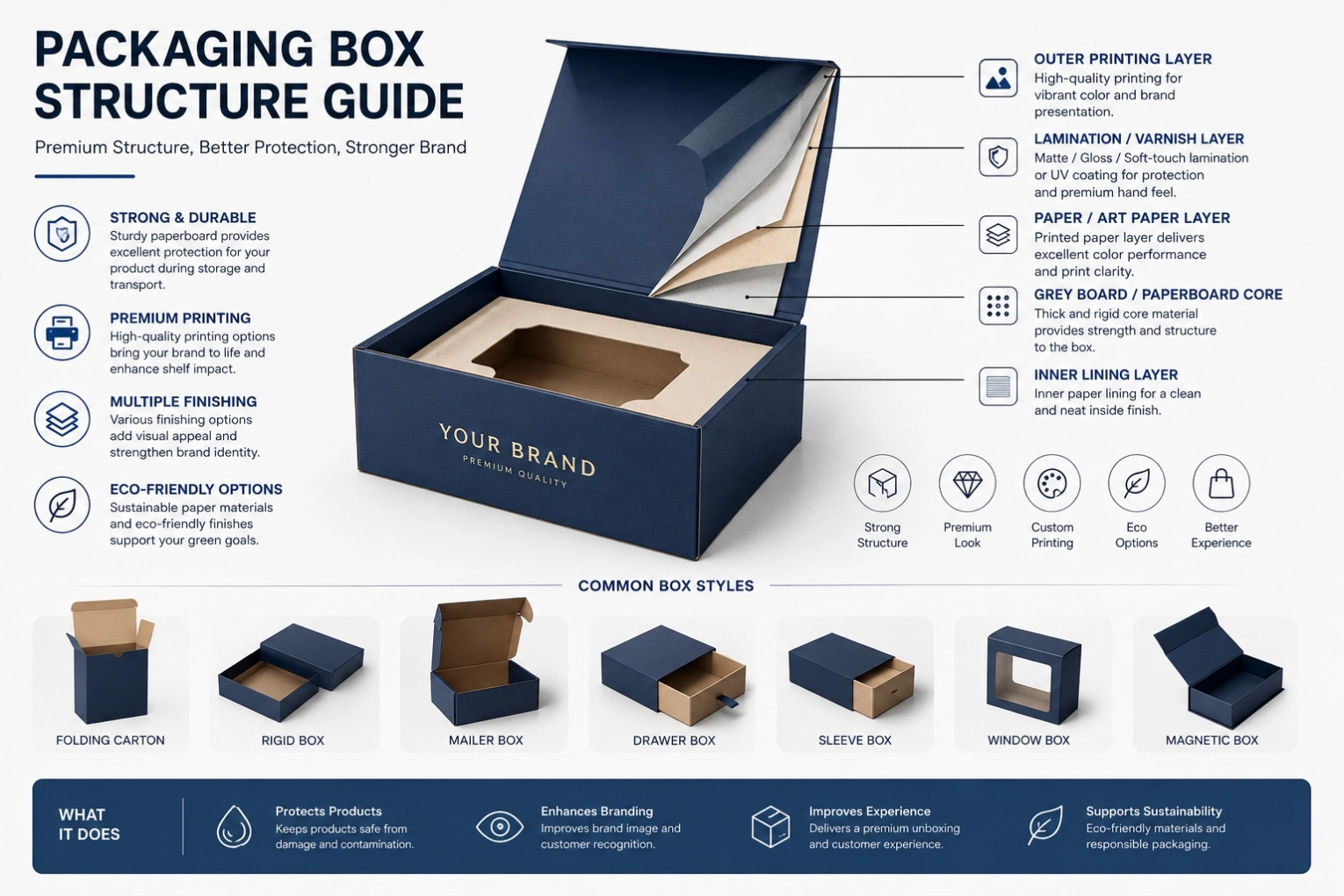
Box Materials, Structure & Printing: A Simple Guide for Custom Packaging
Choosing a custom box can feel a little confusing at the beginning. There are many box styles, paper materials, printing methods, and finishing options.
But honestly, you do not need to know every technical detail.
You only need to understand a few key points:
Will the box protect my product?
Will it look good for my brand?
Will the cost make sense for my order quantity?
That is what this guide is for.
1. Start with Your Product, Not the Box
Before choosing paper or printing, the first question is simple:
What are you packing?
A lightweight skincare bottle, a candle jar, a tea gift set, a jewelry piece, and an e-commerce kit all need different box structures.
For example:
- A small cosmetic bottle may only need a folding carton.
- A glass candle jar may need a stronger box with an insert.
- A premium gift set may look better in a rigid box.
- An online order may need a mailer box that can handle shipping.
So the right box is not always the most expensive one.
The right box is the one that fits your product, brand, and selling channel.
2. Common Box Styles and When to Use Them
Folding Carton
This is one of the most common choices for retail packaging.
It is light, easy to print, cost-friendly, and can be shipped flat before assembly.
Best for: cosmetics, skincare, supplements, tea, small food products, stationery, small electronics, and retail items.
If you are a new brand testing the market, this is often a smart starting point.
Rigid Box
Rigid boxes feel stronger and more premium. They are often used for gift packaging and higher-value products.
Best for: jewelry, luxury cosmetics, candles, electronics, tea gift sets, and premium product kits.
The only thing to keep in mind: rigid boxes usually cost more and take more shipping space because they are not flat-packed like folding cartons.
Mailer Box
Mailer boxes are popular for e-commerce and subscription packaging.
They are stronger than regular folding cartons and can sometimes work as both product packaging and shipping packaging.
Best for: online orders, sample kits, subscription boxes, gift sets, and product bundles.
If your product will be shipped directly to customers, this style is worth considering.
Drawer Box
A drawer box gives a nice opening experience. It feels more special than a normal carton.
Best for: jewelry, beauty products, chocolate, tea, small gifts, and premium samples.
For this box style, size accuracy matters a lot. If the drawer is too tight or too loose, the experience will not feel good.
Window Box
A window box lets customers see the product inside.
Best for: bakery, soap, candles, toys, gifts, and products where the look of the item helps sell it.
A window can be useful, but the window size should be reasonable. If the window is too large, the box may become weaker.
3. Paper Materials: What Should You Choose?
You do not need to memorize every paper name. Here is the simple way to understand it.
White Card Paper
Clean, smooth, and good for colorful printing.
Good for: most retail boxes, cosmetics, skincare, supplements, small food boxes, and general product packaging.
This is a safe and common choice when you want a clean branded look.
Kraft Paper
Natural, simple, and eco-style.
Good for: organic products, handmade products, tea, soap, bakery items, and brands that want a more natural look.
Kraft paper does not always show colors as brightly as white paper, so the design should usually stay simple.
Grey Board
Grey board is usually used inside rigid boxes. Printed paper or specialty paper is mounted on the outside.
Good for: gift boxes, premium boxes, drawer boxes, and magnetic boxes.
If you want a strong and luxury-feeling box, grey board is usually part of the structure.
Corrugated Paperboard
Corrugated board is stronger and better for shipping protection.
Good for: mailer boxes, e-commerce packaging, shipping boxes, and heavier products.
It is a practical choice when protection is more important than a very delicate retail look.
Specialty Paper
Specialty paper has texture, color, or a more premium surface feel.
Good for: luxury products, jewelry, cosmetics, candles, gifts, and high-end branding.
Sometimes a simple logo on nice specialty paper looks better than a complicated full-color design.
4. Printing Options: Keep It Practical
For most custom boxes, the common options are:
- CMYK full-color printing
- Pantone color printing
- Offset printing
- Digital printing
- Flexo printing for some corrugated boxes
Here is the simple version:
For larger orders, offset printing is usually better.
It gives clean color and professional results.
For small test orders or samples, digital printing may be more flexible.
It is useful when you want to test before placing a bigger order.
If your brand color must be accurate, please provide Pantone color codes.
A color on screen can look very different from a printed box.
5. Finishing: Make the Box Feel Better
Finishing is what gives the box its final look and touch.
Common options include:
- Matte lamination
- Gloss lamination
- Soft-touch lamination
- Spot UV
- Hot foil stamping
- Embossing
- Debossing
- Textured paper
You do not need to use all of them.
Actually, using too many finishes can make the box look messy and increase the cost.
For a clean premium look: matte lamination is a safe choice.
For a logo highlight: foil stamping or spot UV works well.
For a luxury feel: embossing, debossing, soft-touch film, or specialty paper can help.
The goal is not to add more.
The goal is to make the box match your brand.
6. Inserts Matter More Than Many People Think
For many products, the insert is what really keeps the product safe and neat inside the box.
Common insert options include:
- Paper insert
- Corrugated insert
- EVA foam insert
- Molded pulp insert
- Clear plastic tray
- Velvet insert
For light products, a paper insert may be enough.
For fragile, heavy, or high-value products, a stronger insert is usually better.
If the product moves around inside the box, the box is not really doing its job.
This is especially important for glass bottles, candles, electronics, jewelry, and gift sets.
7. Eco-Friendly Box Options
Many customers ask for eco-friendly packaging now. That is possible, but it should be chosen carefully.
Eco-friendly options may include:
- Kraft paper
- Recycled paper
- FSC paper options
- Paper inserts
- Molded pulp inserts
- Water-based coating
- Less plastic lamination
A more eco-friendly box does not have to look cheap.
With the right paper, simple printing, and clean structure, eco-style packaging can still look modern and premium.
But we always suggest checking your target market requirements first, especially if you sell food, cosmetics, or regulated products.
8. How to Avoid Overpaying
A beautiful box is good. A beautiful box that fits your budget is better.
Here are a few honest suggestions:
Do not choose a rigid box if a folding carton already works well.
Do not add foil, UV, embossing, and specialty paper all at once unless your brand really needs it.
Do not ignore shipping space. A box may look affordable, but if it takes too much space, freight cost may become a problem.
Always test the box with the real product before mass production.
This is the best way to avoid wrong sizes, weak structure, poor opening experience, or extra cost later.
9. What We Need for a Faster Quote
To recommend a suitable box and give a more accurate quote, you can send us:
- Product type
- Product size and weight
- Box style reference image
- Quantity
- Printing design or logo file
- Preferred box size, if you already have one
- Material or finishing ideas, if any
- Whether you need an insert
- Target market or selling channel
A simple message is enough:
“We need a custom box for this product. Here are the product size, weight, quantity, and reference image. Please suggest a suitable box structure, material, printing, and finishing.”
You do not need to prepare everything perfectly before contacting us.
We can help you sort out the details step by step.
10. Final Thought
Custom box packaging is not just about choosing paper and printing.
It is about making your product easier to sell, safer to ship, and better to present.
A good box should protect the product, support the brand, and make sense for your budget.
Whether you are starting a new product or improving your current packaging, TM-Future can help you compare box structure, paper material, printing, finishing, inserts, and cost options before production.
Send us your product details or reference images, and we will help you find a practical packaging box solution for your brand.