Jun 26, 2026
Custom Packaging Box FAQ: What Buyers Should Know Before Ordering
Learn the key questions about custom packaging boxes, including box styles, materials, printing, inserts, MOQ, samples, production, shipping, and cost-saving tips for new and growing brands.
Custom Packaging Box FAQ: What Buyers Should Know Before Ordering
Choosing a custom packaging box sounds simple at first. You may think, “I just need a box with my logo on it.”
But once the project starts, many real questions come up:
🟢 What box style should I choose?
🟢 What material is strong enough?
🟢 How much does it cost?
🟢 Can I start with a small order?
🟢 Do I need an insert?
🟢 Will the box protect my product during shipping?
This guide answers the most common questions about custom packaging boxes in a clear and practical way. Whether you are launching a new brand or improving your current packaging, it will help you understand what to prepare before requesting a quotation.
1. What information do I need for a custom box quotation?
To get an accurate quotation, you do not need to know every technical detail. But the more basic information you can share, the faster we can suggest a suitable solution.
✅ Helpful information includes:
🟢 Product type
🟢 Product size and weight
🟢 Quantity
🟢 Preferred box style
🟢 Printing design or logo
🟢 Target market or sales channel
🟢 Whether an insert is needed
🟢 Target delivery time
If you are not sure about the box size or structure, that is completely normal. You can simply send product photos and reference packaging. We can help you choose a practical box direction based on your product.
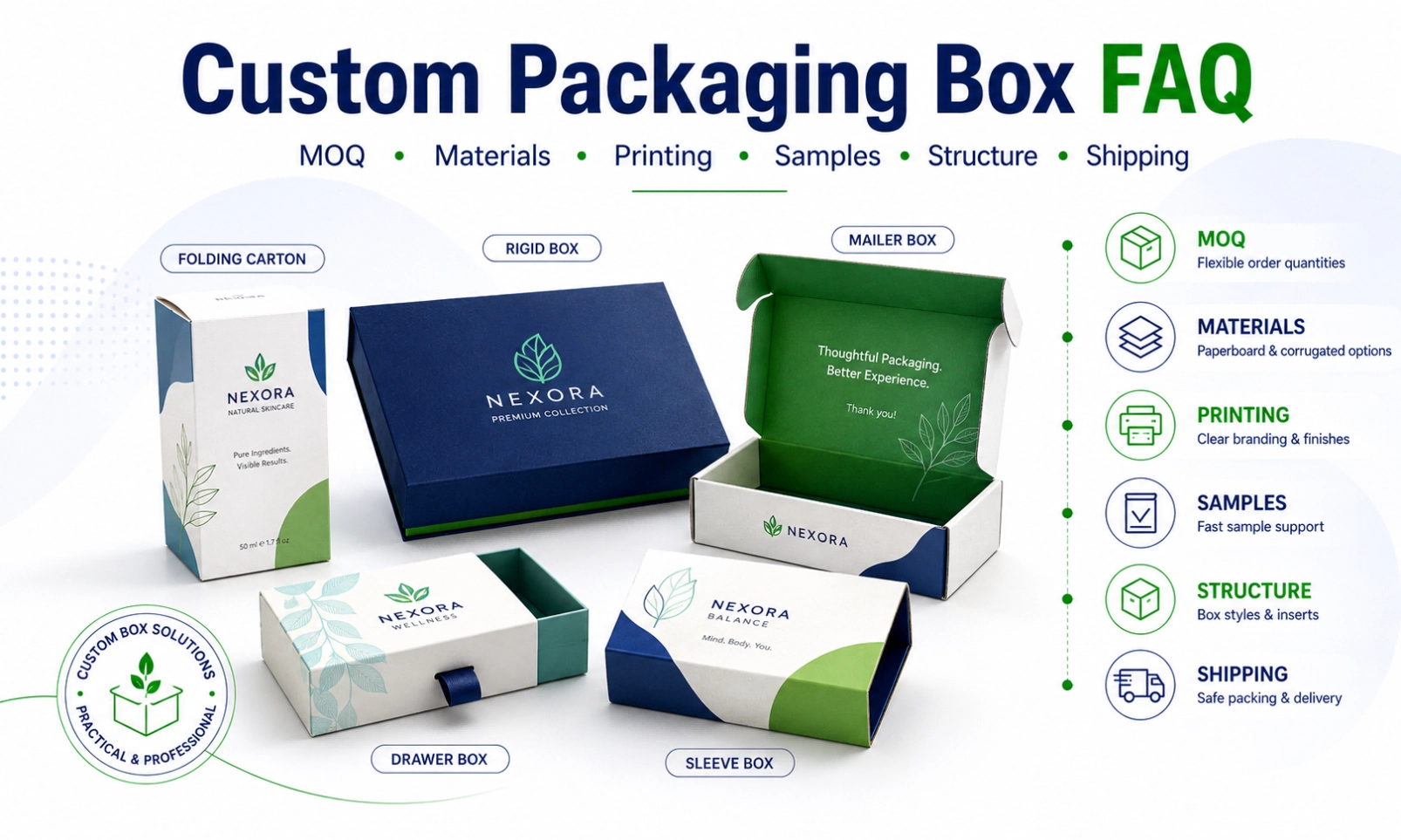
2. What types of packaging boxes can be customized?
Different products need different box structures. A skincare bottle, a chocolate gift set, a candle, and an e-commerce product will not use the same packaging box.
Common custom box types include:
✅ Folding cartons
✅ Rigid gift boxes
✅ Mailer boxes
✅ Drawer boxes
✅ Lid and base boxes
✅ Sleeve boxes
✅ Window boxes
✅ Display boxes
✅ Magnetic closure boxes
✅ Custom insert boxes
🟢 For lightweight retail products, folding cartons are often a cost-effective choice.
🟢 For premium gift products, rigid boxes create a stronger high-end feeling.
🟢 For e-commerce or subscription packaging, mailer boxes are practical and easy to ship.
The best box is not always the most expensive one. The best box is the one that fits your product, budget, sales channel, and customer experience.
3. How do I choose between a folding carton, mailer box, and rigid box?
This is one of the most common questions from buyers.
Folding Carton
A folding carton is lightweight, easy to store, and usually more budget-friendly. It is suitable for cosmetics, skincare, food, tea, supplements, small accessories, and many retail products.
🟢 Best for: retail packaging, small products, cost control, multi-SKU packaging.
Mailer Box
A mailer box is stronger than many thin paper boxes and works well for direct shipping, subscription boxes, influencer kits, and gift sets.
🟢 Best for: e-commerce brands, online orders, product sets, unboxing experience.
Rigid Box
A rigid box is thicker, stronger, and gives a premium gift-box feeling. It is often used for luxury products, jewelry, candles, electronics, cosmetics, and high-value gift sets.
🟢 Best for: premium branding, gift packaging, luxury presentation.
✅ Simple advice:
If you are testing the market, start with a practical structure.
If your product is already positioned as premium, a rigid box may be worth considering.
4. What materials are commonly used for custom packaging boxes?
Packaging boxes can be made from different paper materials depending on the required strength, printing effect, and budget.
Common material options include:
✅ White card paper
✅ Kraft paper
✅ SBS paperboard
✅ CCNB paperboard
✅ Corrugated board
✅ Greyboard for rigid boxes
✅ Specialty paper
✅ Coated paper
🟢 White card paper is clean and good for colorful printing.
🟢 Kraft paper gives a natural and eco-friendly look.
🟢 Corrugated board is stronger and suitable for mailer boxes or shipping boxes.
🟢 Greyboard is commonly used inside rigid gift boxes for a strong structure.
Material choice should not only be based on appearance. It also affects strength, folding performance, printing result, shipping cost, and customer feeling.
5. How do I choose the right paper thickness?
Paper thickness depends on the product size, product weight, box structure, and how the box will be used.
A small skincare carton and a heavy gift set box should not use the same paperboard. If the paper is too thin, the box may feel weak. If it is too thick, the cost may increase and the structure may not fold well.
🟢 For light products, a standard paperboard may be enough.
🟢 For heavier products, stronger paperboard or corrugated material may be better.
🟢 For premium packaging, thicker board can improve the hand feel and presentation.
The most practical way is to confirm the product details first, then choose the material and thickness together.
6. Do I need an insert inside the box?
Not every box needs an insert. But if your product needs to stay in place, avoid shaking, look organized, or be protected during shipping, an insert is very helpful.
Common insert options include:
✅ Paper card insert
✅ Corrugated insert
✅ EVA foam
✅ Sponge foam
✅ Molded pulp insert
✅ Blister tray
✅ Velvet insert
✅ Custom paper structure insert
🟢 For eco-friendly packaging, paper inserts, corrugated inserts, and molded pulp inserts are often better choices.
🟢 For fragile or premium products, foam or custom inserts may offer better protection and presentation.
An insert is not just for protection. It also affects the unboxing experience. A well-designed insert can make the product look more valuable when the customer opens the box.
7. What printing options are available for custom boxes?
Most custom packaging boxes can be printed with logos, product information, brand colors, patterns, barcodes, QR codes, and full-color artwork.
Common printing methods include:
✅ Offset printing
✅ Digital printing
✅ Flexo printing for some corrugated boxes
✅ Screen printing for special effects
🟢 Digital printing is useful for samples, small runs, and multiple designs.
🟢 Offset printing is more common for larger production quantities and better color consistency.
🟢 Flexo printing is often used for some corrugated packaging.
For artwork files, vector formats such as AI, PDF, or EPS are preferred. Please include fonts, linked images, Pantone colors if needed, and clear finishing instructions.
8. Can you match my brand color exactly?
We can follow Pantone colors or reference samples as closely as possible. However, printed color may not look exactly the same as your screen.
Why?
✅ Screens display color with light.
✅ Printing depends on ink, paper, coating, and finishing.
✅ Kraft paper, white card paper, coated paper, and matte surfaces all affect color differently.
🟢 If brand color is very important, we recommend confirming color requirements before mass production.
🟢 For premium brands, a physical sample is often worth doing before a large order.
Small color differences can happen in paper packaging, especially between different production batches.
9. What surface finishes can be added to a packaging box?
Surface finishing can make a box look more premium, more durable, or more brand-specific.
Common finishing options include:
✅ Matte lamination
✅ Glossy lamination
✅ Soft-touch lamination
✅ Varnish
✅ Spot UV
✅ Hot foil stamping
✅ Embossing
✅ Debossing
✅ Window patching
✅ Metallic ink
✅ Textured paper
🟢 Hot foil stamping can make the logo stand out.
🟢 Spot UV can highlight certain design areas.
🟢 Soft-touch lamination gives a smooth premium hand feel.
🟢 Embossing and debossing add texture and depth.
But more finishing does not always mean better packaging. Sometimes a clean design, good material, and strong structure look more professional than too many decorative effects.
10. What is the MOQ for custom packaging boxes?
MOQ depends on the box style, size, material, printing method, finishing, insert, and production process.
In general:
🟢 Folding cartons usually have a more flexible MOQ.
🟢 Mailer boxes may depend on material and printing method.
🟢 Rigid boxes often require more labor and may have a higher MOQ.
🟢 Special inserts or custom structures may increase the starting quantity.
For new brands, small orders may be possible for many box projects. However, the unit price for small quantities is usually higher than bulk production.
✅ If you are testing a new market, a smaller first order can reduce risk.
✅ If your design and sales plan are stable, a larger order can reduce unit cost.
11. Why is a custom box more expensive than expected?
A packaging box may look simple, but many cost factors are involved.
The final price is affected by:
✅ Box size
✅ Paper material
✅ Paper thickness
✅ Printing area
✅ Surface finishing
✅ Box structure
✅ Insert design
✅ Labor complexity
✅ Quantity
✅ Packing volume
✅ Shipping method
🟢 Rigid boxes cost more because they require thicker board, wrapping paper, more manual work, and more shipping space.
🟢 Complex inserts also increase cost because they need extra material, cutting, assembly, and fitting.
🟢 Large boxes may be expensive to ship even if they are not heavy, because shipping cost may be calculated by volume weight.
If budget is limited, we can help simplify the structure, adjust material thickness, reduce finishing, or optimize the box size.
12. How can I reduce packaging box cost without making it look cheap?
Cost control does not always mean making the box worse. Many times, smart structure and material choices can help reduce cost while keeping a professional look.
Practical ways to reduce cost include:
✅ Simplify the box structure
✅ Reduce unnecessary surface finishing
✅ Choose a more suitable paper thickness
✅ Avoid oversized packaging
✅ Use paper inserts instead of expensive inserts
✅ Reduce too many small-batch designs
✅ Choose flat-packed structures when possible
✅ Increase quantity if the design is stable
🟢 A slightly smaller box can reduce material cost and shipping volume.
🟢 A clean design with good printing can look better than a complicated box with too many finishes.
🟢 For new brands, practical packaging is often better than over-designed packaging.
13. Can I start with a small order first?
Yes, in many cases. Small orders are helpful for new brands, seasonal packaging, market testing, influencer kits, and product launches.
However, buyers should understand one thing:
🟢 Small quantity does not always mean low total setup cost.
🟢 Custom printing, cutting, sampling, and setup still require time and labor.
🟢 That is why small-order unit prices are usually higher.
If you have several SKUs, flavors, or product versions, please tell us early. We can check whether the designs can be produced together in a more efficient way.
14. Do I need a sample before mass production?
For most custom box projects, samples are strongly recommended, especially if the structure, size, insert, or printing effect is important.
Common sample types include:
✅ Blank structure sample
✅ Digital printed sample
✅ Material swatch
✅ Existing box sample
✅ Pre-production sample
🟢 A blank sample helps check size, folding, structure, and product fit.
🟢 A printed sample helps check artwork layout and general appearance.
🟢 A pre-production sample is closer to the final mass production result.
Samples can help avoid costly mistakes before bulk production.
15. Will the sample be exactly the same as mass production?
It depends on the sample type.
A digital sample is useful for checking layout, size, and structure, but color and finishing may be slightly different from mass production. A pre-production sample is usually closer to the final result.
🟢 If color, material feel, or finishing is very important, please confirm this before ordering samples.
🟢 If the box must hold the product tightly, please test the real product with the sample.
Packaging is not only about how it looks in photos. It should also work in real packing, shipping, and customer use.
16. Can paper boxes be used for food packaging?
Yes, paper boxes are widely used for food packaging, especially as outer packaging.
Common food uses include:
✅ Tea boxes
✅ Coffee boxes
✅ Chocolate boxes
✅ Bakery boxes
✅ Snack boxes
✅ Health food boxes
✅ Gift set boxes
But one important question must be confirmed:
🟢 Does the food directly touch the paper box?
If the food is already packed inside a pouch, wrapper, tray, or liner, the paper box is usually outer packaging. If the food touches the paper directly, food-contact material requirements must be discussed before production.
17. Can packaging boxes be eco-friendly?
Yes. Many buyers now want packaging that looks natural, uses less plastic, and is easier to recycle.
Eco-friendly options may include:
✅ Kraft paper
✅ Recycled paper
✅ FSC paper if required
✅ Plastic-free structure
✅ Molded pulp inserts
✅ Paper card inserts
✅ Reduced lamination
✅ Simple printing design
🟢 Eco-friendly packaging should still protect the product.
🟢 A recyclable box that fails during shipping is not a good solution.
🟢 The right eco option depends on your product, market, and budget.
If sustainability is important for your brand, please mention this at the beginning of the project.
18. How long does custom box production take?
Production time depends on box type, material, printing, finishing, quantity, sample approval, and factory schedule.
In general:
🟢 Simple folding cartons are usually faster.
🟢 Rigid boxes take longer because they involve more manual work.
🟢 Boxes with inserts, foil stamping, embossing, or special paper may need extra time.
🟢 Urgent orders should be discussed before confirming artwork and payment.
Production usually starts after the order, payment, dieline, artwork, material, and sample are confirmed.
19. Can I change the artwork after confirming the order?
If production has not started, changes may be possible. But once printing plates, material preparation, cutting, or printing have started, changes may cause extra cost or delay.
✅ Before final approval, please check carefully:
🟢 Logo
🟢 Text
🟢 Barcode
🟢 QR code
🟢 Product information
🟢 Spelling
🟢 Color instructions
🟢 Finishing position
🟢 Box direction and opening style
A small artwork mistake can affect the whole order, so final checking is very important.
20. How are custom boxes packed and shipped?
Different box styles are packed differently.
🟢 Folding cartons and some mailer boxes can usually be packed flat to save space.
🟢 Rigid boxes are usually pre-assembled and take more carton volume.
🟢 Boxes with inserts may need special packing to avoid deformation.
🟢 Large or assembled boxes may have higher shipping costs because of volume weight.
Shipping options can include express, air freight, sea freight, or door-to-door delivery, depending on your quantity, destination, budget, and delivery time.
21. Why is shipping for boxes sometimes expensive?
Paper boxes are often light but bulky. For international shipping, carriers may calculate cost by volume weight instead of actual weight.
This means a box order may not be very heavy, but it can still take a lot of space.
🟢 Flat-packed boxes can help reduce shipping volume.
🟢 Rigid boxes usually cost more to ship because they cannot be flattened.
🟢 Optimizing box size can reduce both material cost and shipping cost.
This is why packaging design should consider not only the box itself, but also storage, packing, and shipping.
22. What quality points should be checked before shipping?
Before shipment, the key quality points usually include:
✅ Printing clarity
✅ Color consistency
✅ Cutting accuracy
✅ Folding lines
✅ Glue position
✅ Box shape
✅ Surface finishing
✅ Insert fitting
✅ Quantity
✅ Packing condition
✅ Visible defects
🟢 Small tolerances can happen in paper packaging because of cutting, folding, paper thickness, and manual assembly.
🟢 For tight-fit products, sample testing is very important before mass production.
Good packaging should look good, assemble smoothly, hold the product properly, and survive normal handling.
23. What if I find a quality issue after receiving the goods?
If you find any issue after receiving the goods, please take clear photos and videos as soon as possible.
Please provide:
✅ Photos of the affected boxes
✅ Photos of the outer cartons
✅ Quantity affected
✅ Carton marks
✅ Shipping label photos
✅ Clear description of the issue
This helps us understand whether the issue came from production, packing, handling, or transportation.
🟢 Clear evidence makes problem-solving much faster.
🟢 We will review the case and discuss a reasonable solution based on the actual situation.
24. Can I reorder the same packaging later?
Yes. For repeat orders, please provide the previous order information, artwork version, box photo, or size details.
If you need to update the artwork, add new flavors, change product information, or adjust the box size, please clearly mark the new version.
🟢 Repeat orders are usually easier when the dieline, material, and production details are already confirmed.
🟢 If your brand plans to launch more SKUs later, it is better to build a consistent packaging system from the beginning.
This helps keep your product line clean, organized, and professional.
Final Advice: Start With the Product, Not Just the Box
A good custom packaging box should not only look nice. It should fit the product, protect it, support your sales channel, match your brand position, and stay within your budget.
Before choosing the most expensive structure or the most complicated finish, ask these questions first:
🟢 Where will this product be sold?
🟢 Will it be shipped directly to customers?
🟢 Does it need an insert?
🟢 Is the product fragile?
🟢 Is the brand premium, natural, simple, or colorful?
🟢 Is this a test order or a long-term product line?
🟢 What budget range makes sense for this market?
If you are not sure which box fits your product, send us your product photo, size, quantity, target market, and reference packaging. We can help recommend a practical box style, material, insert option, printing method, and cost direction for your project.
✅ The right packaging box is not only about appearance.
✅ It should make your product easier to sell, easier to ship, and easier for customers to trust.