
Jun 26, 2026
How to Start a Custom Packaging Project
A practical beginner guide for starting a custom packaging project, including pouches, boxes, inserts, materials, printing, MOQ, and production steps.
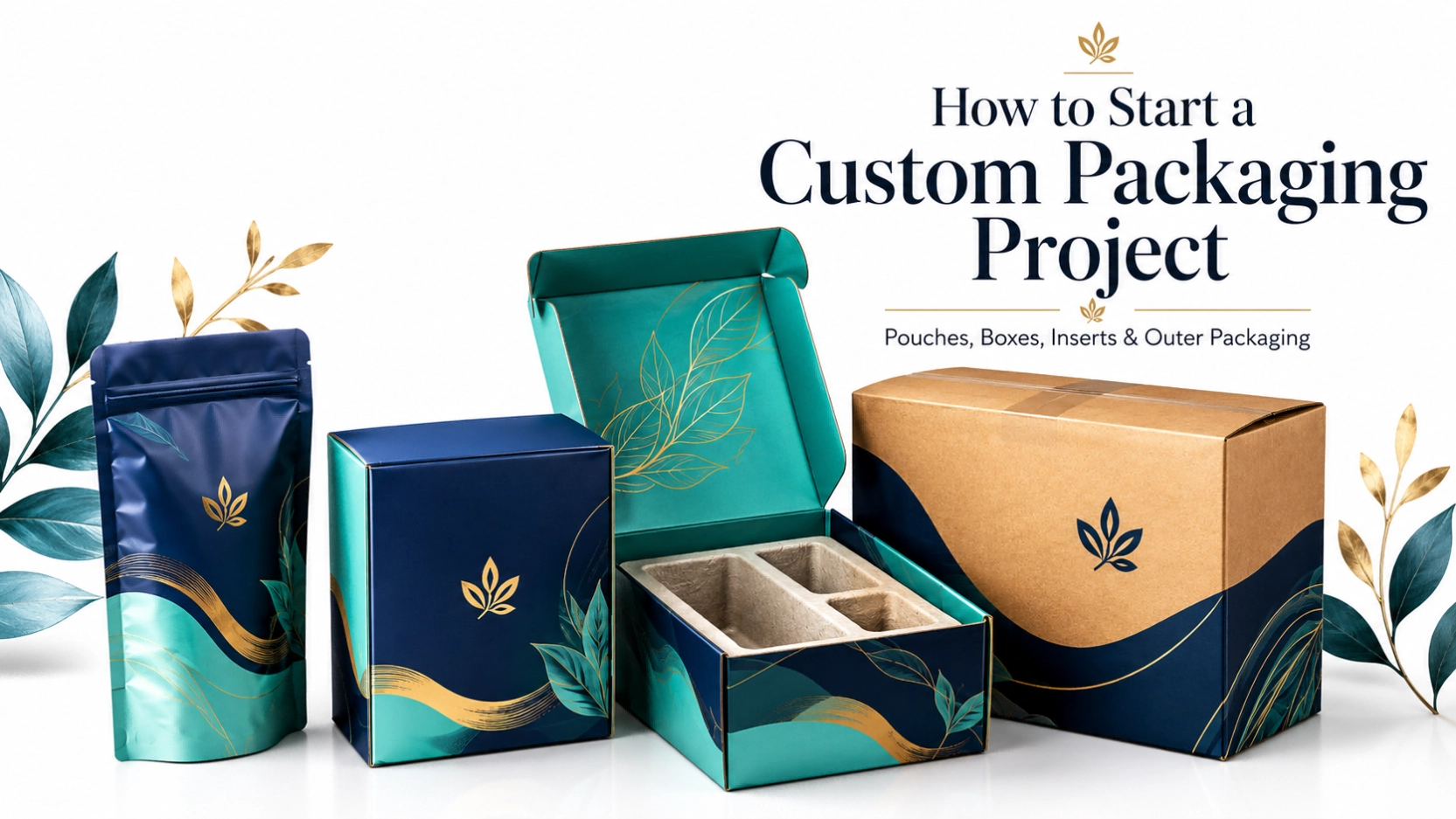
How to Start a Custom Packaging Project
Pouches, Boxes, Inserts & Outer Packaging
Starting a custom packaging project can feel confusing, especially if this is your first time.
You may already know your product very well, but packaging brings a lot of new questions:
What size should I choose?
Should I use a pouch or a box?
Do I need an insert?
What material is right?
How can I make the packaging look good without making the cost too high?
🟢 Good news: You do not need to understand every packaging detail before contacting us.
You only need to share your product information, your idea, and your target quantity. We can help you sort out the right packaging direction step by step.
This guide is written for new brands, small businesses, product developers, and buyers who want to start a custom packaging project in a clear and practical way.
1. Start with Your Product First
Before choosing a pouch, box, insert, or outer carton, the first thing we need to understand is your product.
Different products need different packaging. A coffee bag, a snack pouch, a skincare sample box, and a gift set may all need “custom packaging”, but the structure and material can be very different.
You can start with a few simple questions:
What product are you packing?
How much product goes into each pack?
Is it powder, liquid, dry food, oily product, frozen food, fragile item, or something sensitive to moisture?
Will it be sold online, in retail stores, at markets, or used as a sample?
Does the customer need to open and reseal the pack?
🟢 Key point: The right packaging starts from your product, not from a nice-looking photo.
Reference photos are helpful, but they are only references. Your product weight, shelf life, shipping method, and sales channel are what really decide the best packaging solution.
2. Think About the Full Packaging Set
Many new customers think custom packaging means only one bag or one box.
In real projects, packaging is often a full set.
For example:
A snack brand may need a printed pouch plus a display box.
A skincare sample kit may need sachets, a folding box, and a paper insert.
A gift product may need an inner bag, a rigid box, an insert, and an outer sleeve.
An online store may also need a stronger shipping carton.
🟢 Key point: Good packaging is not only about looking nice. It should also protect the product, support your sales, and survive shipping.
So before choosing materials, it is better to think about the full packaging journey:
Inner packaging
Retail packaging
Insert or tray
Outer shipping carton
You may not need all of them, but it is worth checking before production.
3. Choose the Packaging Type That Fits Your Product
There is no single “best” packaging type. The right choice depends on your product, budget, quantity, shelf display, and customer experience.
Pouches
Pouches are a good choice for food, coffee, tea, powders, pet products, supplements, refills, and many daily-use products.
They are lightweight, flexible, and usually easier to start with for small and medium brands.
Common options include stand-up pouches, flat bottom pouches, three-side seal pouches, sachets, spout pouches, and shaped pouches.
🟢 Best for: Products that need flexible filling, lighter shipping weight, good barrier protection, and custom printed branding.
Boxes
Boxes are useful when you want the product to look more structured, more retail-ready, or more premium.
Folding cartons are common for retail products. Rigid boxes are often used for gift sets or higher-end products.
🟢 Best for: Cosmetics, tea, chocolate, sample kits, small products, gift sets, health products, and retail packaging.
A box can make your product look more complete, especially when it is sold as a set or displayed on a shelf.
Inserts
Inserts help hold the product in place inside the box.
They are useful when the product is fragile, has multiple pieces, or needs a cleaner unboxing experience.
Common insert options include paperboard inserts, corrugated inserts, molded pulp, EVA, foam, and plastic trays.
🟢 Best for: Bottles, jars, sample sets, fragile items, gift boxes, and products that should not move around inside the box.
If your product shakes inside the box, the box alone is not enough. You may need an insert.
Outer Packaging
Outer packaging is mainly for shipping, storage, warehouse handling, and export.
It may not be seen by the final customer, but it is very important.
🟢 Key point: Beautiful retail packaging still needs strong outer packaging to arrive safely.
If the outer carton is too weak, the inside product may still get damaged during shipping, even if the retail box looks good.
4. What Information Should You Prepare?
You do not need a perfect brief. A simple message is enough to start.
But if you can share the basic information below, we can give you better suggestions faster.
Please prepare:
Product type
Product size or filling weight
Target quantity
Packaging style you like
Reference photos if you have them
Logo or artwork if available
Selling country or market
Special needs, such as zipper, valve, window, handle, insert, or outer box
🟢 Do not worry if you do not know the exact size or material.
Many customers come to us with only a product photo and a rough idea. That is completely fine. We can help estimate the structure, size, and material based on your product.
5. Do Not Choose Packaging Only by Price
We understand that budget matters, especially for new brands.
But the cheapest packaging is not always the safest choice.
If the pouch material is too weak, it may leak or break during sealing.
If the box is too thin, it may deform during shipping.
If there is no insert, the product may move around and get damaged.
If the structure is not suitable, the packaging may look good but fail in real use.
At the same time, you do not always need the most expensive option.
🟢 Better question: “What packaging is suitable enough for my product, market, and budget?”
For example:
Coffee may need aroma protection and a degassing valve.
Powder products may need moisture resistance and strong sealing.
Frozen food may need materials that handle low temperatures.
Gift boxes may need stronger paperboard and better finishing.
Fragile products may need inserts, not just a nice-looking box.
Good packaging should balance protection, appearance, cost, and quantity.
6. Start Practical, Then Upgrade Later
Many new brands want premium custom packaging from the beginning. That is understandable. Packaging is part of your brand image.
But if your product is still being tested, it may be smarter to start with a practical solution first.
For early-stage brands, we usually suggest:
Start with one main size first.
Do not make too many SKUs at the beginning.
Choose a mature packaging structure.
Keep the design clean and easy to print.
Start with a reasonable quantity.
Use labels or stickers for very small test batches if needed.
Upgrade the full custom packaging after sales become more stable.
🟢 Key point: Your first packaging does not need to be perfect. It needs to be suitable for your current stage.
You can always improve the structure, material, finishing, and branding later.
7. Artwork Is More Important Than Many Beginners Think
A good structure with poor artwork can still look unfinished.
A simple package with clean artwork can look very professional.
Before production, your artwork should include the basic information needed for printing and selling.
This may include:
Logo
Product name
Net weight or volume
Product details
Ingredients if needed
Barcode if required
Market-required text
Color information
High-resolution images
Editable design file if possible
🟢 Key point: Clean artwork helps your packaging look more trustworthy and market-ready.
If you only have a logo and a rough idea, you can still contact us first. But before mass production, the artwork needs to be checked carefully.
8. Samples Help You Avoid Guessing
Samples are very useful, especially for new customers.
Photos can show the look, but samples help you feel the material, check the size, understand the structure, and see whether the packaging works for your product.
Different samples have different purposes.
Existing samples can show material, thickness, structure, and finishing.
Digital samples can show approximate layout and size.
Pre-production samples are closer to final production, but they usually cost more and take more time.
🟢 Key point: Samples help reduce risk before mass production.
Just remember: not every sample is exactly the same as final mass production unless it is a confirmed pre-production sample.
9. Common Mistakes New Customers Should Avoid
Here are some common problems we often see in custom packaging projects.
Choosing packaging only because it looks good
A reference photo may look beautiful, but it may not fit your product size, filling method, budget, or shipping needs.
Asking for the lowest price too early
Without product details, the quote may not be accurate. A lower price may also mean a weaker material or unsuitable structure.
Making too many sizes at the beginning
Too many SKUs can increase cost, production difficulty, and inventory pressure.
Ignoring shipping and storage
Packaging should not only look good on a shelf. It should also handle transport, stacking, cartons, and warehouse storage.
Copying another brand’s packaging directly
Reference photos are helpful, but your product, quantity, and market may need a different solution.
Preparing artwork too late
Production cannot move smoothly if artwork is incomplete or not checked.
🟢 Key point: The goal is not to make packaging complicated. The goal is to avoid simple mistakes before they become expensive.
10. A Simple Custom Packaging Process
If you are not sure where to start, you can follow this simple process.
Step 1: Tell us about your product
Share the product type, filling weight, product size, selling market, and how the packaging will be used.
Step 2: Choose the packaging direction
Decide whether you need pouches, boxes, inserts, outer cartons, or a full packaging set.
Step 3: Confirm the size and structure
If you are not sure, we can help estimate the size based on your product and reference photos.
Step 4: Choose material and finishing
This depends on product protection, budget, brand style, and sales channel.
Step 5: Prepare artwork
Send your logo, design file, product text, barcode, and any required market information.
Step 6: Check samples or references
Confirm the size, material feel, structure, and general appearance.
Step 7: Start production
Once the details are confirmed, production can begin.
Step 8: Arrange packing and shipping
Confirm carton packing, shipping method, and delivery destination.
🟢 Key point: A clear process saves time and helps the project move smoothly.
11. What Should You Send When Contacting Us?
You do not need to send a perfect packaging brief.
A simple message is enough.
You can send us:
Product photo
Product size or weight
Reference packaging photos
Target quantity
Logo or design draft if available
Selling country or market
Special concerns, such as moisture protection, premium look, low MOQ, eco-friendly material, retail display, or shipping protection
Here is a simple message you can use:
“Hi, we are looking for custom packaging for our product. The product is [product type], about [weight/size] per pack. We are considering [pouch/box/insert/outer packaging], and our first order quantity may be around [quantity]. Could you suggest a suitable packaging structure and material?”
🟢 Even if your idea is not complete yet, you can still contact us. We can help you organize the details step by step.
Final Thoughts
Custom packaging does not need to be complicated at the beginning.
You do not need to know every material, every structure, or every printing method. That is what a packaging supplier is here for.
What matters most is that we understand your product, your market, your budget, and your current business stage.
Whether you need flexible pouches, folding boxes, rigid boxes, paper inserts, trays, sleeves, or outer cartons, we can help you build a practical packaging solution step by step.
🟢 Starting a new packaging project? Send us your product details and reference ideas. We will help turn them into a clear, workable packaging plan.