
Jun 26, 2026
How to Choose the Right Custom Box Style for Your Product
A simple guide to help brands choose the right custom box style based on product size, shipping needs, retail display, budget, and brand presentation.
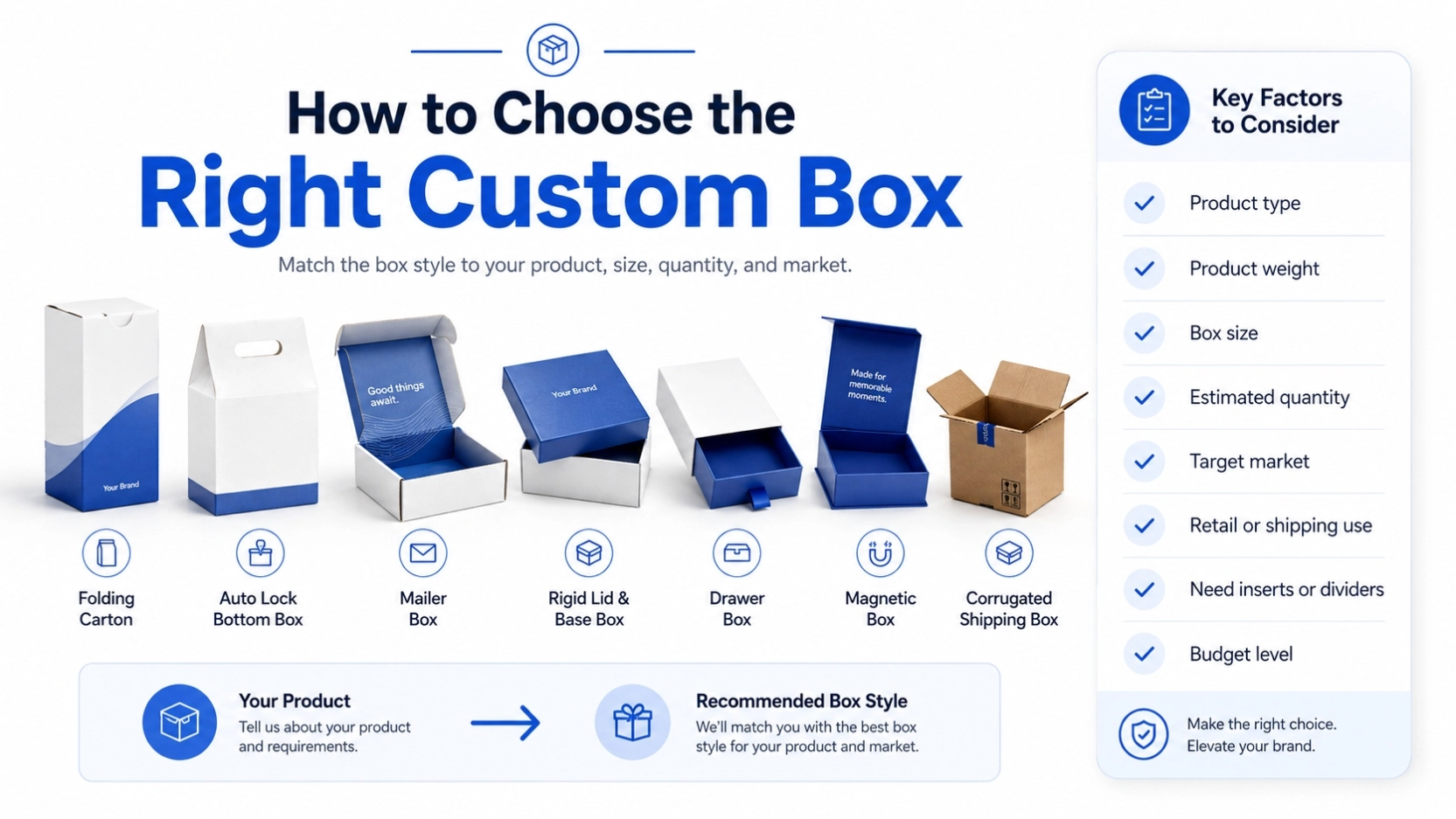
How to Choose the Right Custom Box Style for Your Product
Choosing a custom box is not just about finding a good-looking design.
A box needs to fit your product, protect it during shipping, match your sales channel, and make the customer feel the product is worth buying.
That is why we usually do not suggest choosing a box only from a reference photo. A nice photo is a good starting point, but the right box style should be based on your real product, order quantity, budget, and market use.
✔ A good box should look right, pack well, ship safely, and fit your budget.
1. Start With Your Product, Not the Box Style
Before choosing a box, it helps to answer a few simple questions:
✔ What product will go inside?
✔ What is the product size and weight?
✔ Is it for retail shelf, e-commerce shipping, gift packaging, or outer protection?
✔ Do you need an insert, divider, window, sleeve, or handle?
✔ What is your estimated quantity and budget level?
These details help us recommend a box that actually works, not just one that looks nice on screen.
For example, a skincare bottle, a jewelry bracelet, a tea gift set, and an e-commerce sample kit may all need very different box structures.
2. Folding Carton Boxes: Simple, Clean, and Cost-Friendly
Folding cartons are one of the most common choices for retail packaging.
They are often used for cosmetics, skincare, supplements, tea, snacks, candles, small electronics, health products, and daily consumer goods.
They are lightweight, easy to print, and can usually be shipped flat before packing.
✔ Best for: retail products, light to medium-weight items, and brands that need a clean custom box without high packaging cost.
Common options include straight tuck end boxes, reverse tuck end boxes, auto-lock bottom boxes, sleeve boxes, window boxes, and hang tab boxes.
If your product is not too heavy and you want a practical retail box, folding cartons are often a safe starting point.
3. Auto-Lock Bottom Boxes: Better for Heavier Products
If your product has more weight, a simple tuck-end box may not be strong enough at the bottom.
Auto-lock bottom boxes, also called crash lock bottom boxes, are easier to assemble and provide better bottom support.
They are often used for bottles, jars, candles, cosmetic containers, health products, and slightly heavier retail goods.
✔ Best for: products that need stronger bottom support and faster packing.
This type of box may cost a little more than a basic tuck box, but it can save time during packing and reduce the risk of the bottom opening.
For larger orders, packing efficiency matters. A cheaper box is not always cheaper if it takes too long to fold.
4. Rigid Boxes: Premium Look for Gift and High-Value Products
Rigid boxes are used when the packaging needs to feel more premium.
They are common for jewelry, perfume, beauty gift sets, premium skincare, electronics, tea gift boxes, chocolate, corporate gifts, and wellness products.
Compared with folding cartons, rigid boxes feel stronger, heavier, and more gift-ready.
✔ Best for: premium products, gift sets, and brands that want a stronger first impression.
A rigid box can make the product feel more valuable before the customer even opens it.
But it is also more expensive and takes more space during shipping. So it is usually better for products with enough margin or strong brand positioning.
5. Drawer Boxes: Good for Unboxing Experience
Drawer boxes are also called slide boxes. They are a good choice when you want the packaging to feel more interactive.
They are often used for jewelry, cosmetics, perfume sets, tea gift sets, electronics accessories, stationery, subscription boxes, and small gift products.
✔ Best for: products where opening experience matters.
A drawer box can be paired with a ribbon pull, paper insert, EVA insert, foam insert, molded pulp tray, or printed sleeve.
One important detail: the fit needs to be tested. If the drawer is too tight, it is hard to open. If it is too loose, the box may feel cheap.
6. Magnetic Closure Boxes: Easy to Open, Premium to Hold
Magnetic closure boxes are popular for gift sets and higher-end products.
They are easy to open and close, and they give the packaging a clean, refined feeling.
They are often used for skincare sets, perfume, electronics, jewelry, corporate gifts, sample kits, and premium retail boxes.
✔ Best for: premium kits, gift packaging, and products where presentation is part of the value.
Magnetic boxes are not usually the lowest-cost option, but they can work very well when the packaging needs to support a higher product price.
7. Mailer Boxes: Practical for E-Commerce and Subscription Packaging
Mailer boxes are widely used for e-commerce brands, sample kits, PR packages, subscription boxes, and direct-to-customer shipping.
They are usually made from corrugated paperboard, which gives better protection than a thin folding carton.
✔ Best for: online orders, subscription boxes, sample boxes, and branded shipping.
A mailer box should not only look good when opened. It also needs to survive courier handling, stacking, and long-distance shipping.
If your product will be shipped directly to customers, box strength and fit are very important.
8. Corrugated Shipping Boxes: Protection Comes First
Corrugated shipping boxes are mainly used for outer packaging, export cartons, warehouse storage, bulk shipping, and logistics protection.
They may not look as beautiful as retail boxes, but they are very important.
✔ Best for: outer cartons, heavy products, fragile items, export packaging, and e-commerce logistics.
A beautiful inner box can still arrive damaged if the outer carton is too weak.
For export or e-commerce shipping, it is better to consider the product, inner box, outer carton, packing quantity, pallet loading, and shipping method together.
9. Window Boxes: Let Customers See the Product
Window boxes are useful when customers need to see the product before buying.
They are often used for bakery products, candy, toys, candles, cosmetics, handmade products, and retail display items.
✔ Best for: products where color, shape, or texture helps the sale.
A clear window can build trust because the customer can see what is inside.
But a window can also affect box strength, cost, recyclability, and production complexity. If your product does not need to be seen, a window may not be necessary.
10. Display Boxes: Made for Shelf and Counter Sales
Display boxes are designed for retail shelves, counters, supermarkets, pharmacies, trade shows, and checkout areas.
They are often used for sachets, small snacks, candy, sample products, supplements, small cosmetics, and promotional products.
✔ Best for: small products that need to be displayed clearly and picked up easily.
A display box is not just packaging. It is also a small selling tool.
The box height, opening angle, product quantity, and front display area should all be planned based on where the box will be placed.
11. Paper Tube Boxes: Special Shape and Strong Shelf Recognition
Paper tube boxes are often chosen when a brand wants something different from a regular square or rectangular box.
They are commonly used for tea, coffee, snacks, chocolate, candles, cosmetics, essential oils, gifts, posters, or rolled products.
✔ Best for: products that need a special shape or stronger shelf recognition.
Paper tubes can look natural, premium, or eco-friendly depending on the material and print style.
However, they cannot be shipped flat like folding cartons, so storage and shipping space should be considered.
12. Inserts and Trays: The Box Is Only Half of the Packaging
Many customers focus on the outside box first. But for many products, the insert is just as important.
Inserts help hold the product in place, improve presentation, and reduce damage during shipping.
Common options include paperboard inserts, corrugated inserts, EVA foam, sponge foam, molded pulp trays, plastic trays, dividers, and custom die-cut inserts.
✔ Best for: fragile products, gift sets, bottles, jars, jewelry, electronics, and multi-piece kits.
If the product moves inside the box, the packaging may still fail even if the outside box is strong.
So the box and the insert should be planned together.
Quick Guide: Which Box Style Should You Choose?
Box Style | Good For | Main Advantage |
|---|---|---|
Folding Carton | Retail products, cosmetics, food, supplements | Cost-friendly and printable |
Auto-Lock Bottom Box | Bottles, jars, candles, heavier products | Stronger bottom and faster packing |
Rigid Box | Gifts, jewelry, premium products | Premium look and stronger presentation |
Drawer Box | Jewelry, cosmetics, gift sets | Better unboxing experience |
Magnetic Box | Premium kits, gifts, electronics | Easy opening and high-end feel |
Mailer Box | E-commerce, samples, subscription boxes | Good protection and branded shipping |
Corrugated Shipping Box | Outer cartons, export, logistics | Better protection and stacking strength |
Window Box | Bakery, candy, toys, candles | Shows the product directly |
Display Box | Counters, shelves, small products | Helps products sell in-store |
Paper Tube Box | Tea, coffee, candles, gifts | Special shape and strong recognition |
Sleeve Box | Multi-SKU or seasonal packaging | Flexible and cost-efficient |
Insert / Tray | Fragile or multi-piece products | Holds products in place |
A Simple Way to Decide
If you are not sure which box style to choose, start with this:
✔ For simple retail packaging: choose a folding carton.
✔ For heavier retail products: choose an auto-lock bottom box.
✔ For premium gift packaging: choose a rigid box, drawer box, or magnetic box.
✔ For e-commerce shipping: choose a mailer box or corrugated box.
✔ For fragile products: add a proper insert or tray.
✔ For retail display: consider a window box or display box.
The best box is not always the most expensive one. It is the one that fits your product, protects it properly, and makes sense for your market.
What We Need Before Recommending a Box
To suggest the right box style, we usually need:
✔ Product type
✔ Product size and weight
✔ Quantity per box
✔ Reference photos if available
✔ Sales channel: retail, e-commerce, gift, wholesale, or subscription
✔ Estimated order quantity
✔ Budget level
✔ Need for insert, window, sleeve, handle, or hang hole
✔ Artwork status
✔ Shipping method
With these details, we can recommend a more suitable structure instead of guessing.
How TM-Future Can Help
TM-Future supports custom packaging solutions including folding cartons, rigid boxes, mailer boxes, drawer boxes, magnetic boxes, display boxes, inserts, sleeves, and flexible pouch packaging.
For new brands, we can help choose practical box structures for low MOQ testing, multi-SKU launches, and first-time retail packaging.
For experienced buyers, we can support structure adjustment, material selection, insert planning, printing suggestions, and cost optimization.
✔ Our goal is not to push the most expensive box.
✔ Our goal is to help you choose packaging that fits your product, protects it well, looks right for your market, and works within your real budget.
Final Thought
Before ordering custom boxes, do not only ask:
“Can you make this box?”
A better question is:
“Is this the right box style for my product?”
That question can save time, reduce risk, and help your packaging work better from the first order.